Builder
Kraut Guitars
US · AZ · by Raymond Kraut
Roberto-Venn, then apprenticed under Ervin Somogyi in Oakland — The Somogyi school
Try one in person at 2 dealers · see them on the map →
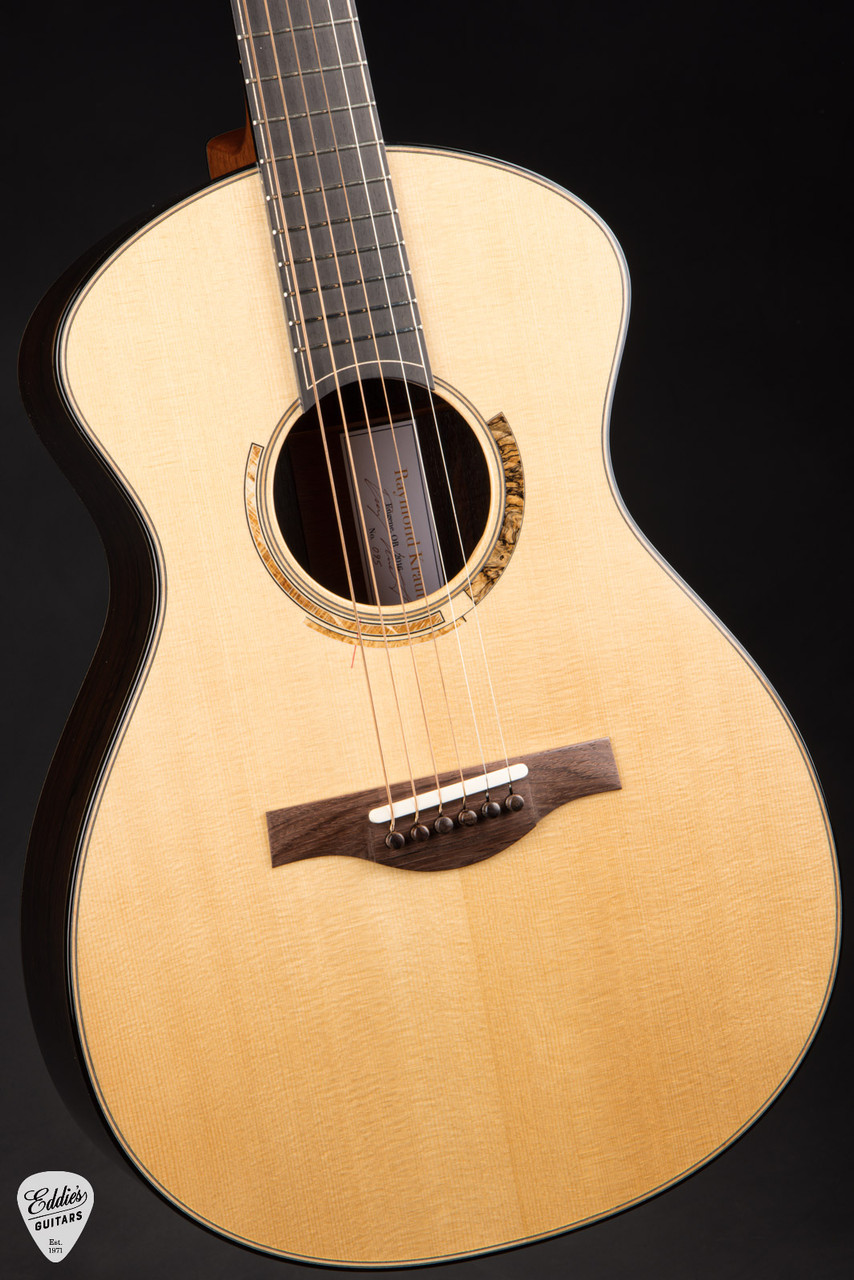
Raymond Kraut came to lutherie through the Roberto-Venn School of Luthiery in Phoenix, and left it with a recommendation that changed his life: his instructor John Reuter pointed him toward Ervin Somogyi, the Oakland master whose name is shorthand for the modern responsive steel-string. Kraut survived a week-long working interview in Somogyi's shop and stayed two years as his third apprentice — years he describes as among the most demanding lessons of his life. The discipline took. For over a decade he built from a converted schoolhouse in Lorane, Oregon, outside Eugene, earning a place at the shows where the craft's standard is set — Healdsburg, the Woodstock Invitational, the Holy Grail show in Berlin — before relocating to the Sonoran Desert north of Tucson, where he built his own workshop (and his own home) on acreage at the foot of the Tortolita Mountains. The word at the center of the Somogyi school is responsiveness, and Kraut's stated ambition is the optimally responsive guitar — not one attribute but all of them at once: aesthetics, engineering, sound, and feel. His construction is light and quietly modern — a removable dovetail neck that allows a smaller head block, resilient voicing informed by contemporary acoustic physics — and no two instruments share a rosette. What most distinguishes his recent work, though, is how openly it draws on the visual arts. Kraut is a devoted student of art and architecture — the kind of traveler who plans trips around buildings — and his Nouveau designs translate that eye into lutherie: minimalist lines and layering, fine-routed geometric inlay in the Bauhaus spirit, and small soundports placed like windows in a facade. The experiments stay in service of the voice; the guitars remain traditional in tone. The desert has also given Kraut a second practice. Through Derrio Wood Co he sources and supplies tonewood — most notably desert ironwood, a wood he has championed from his own backyard landscape — and teaches lutherie to a community of builders. His output remains deliberately small: a handful of guitars a year across the modified dreadnought, OM, and 00, each built to the player and designed, as he puts it, as a single unified aesthetic entity.